12 Dec 2025
Building the Resilient Brain: Your Guide to Cognitive Fitness in the Age of AI
By Dr. Nkouonlack Cyrille
In a world increasingly shaped by Artificial Intelligence and Digital Technology, we are witnessing an era of unprecedented speed and complexity. Algorithms predict our needs, devices extend our senses, and information streams constantly bombard us. But amidst this rapid evolution, one core system remains the ultimate differentiator, the most powerful processor of all: the Human Brain.
The future isn't just about the next innovation in AI; it's about the capacity of the human brain to guide it. Our cognitive resilience, our ability to adapt, create, and maintain wisdom in a sea of information — this is the new frontier. Brain Health is no longer a passive concern; it is the active ingredient for a thriving human future.
What is Brain Health and why is it important?
Brain health is the optimal functioning of the brain across all domains (cognitive, sensory, emotional, behavioural, and motor), which allows an individual to realize their full potential throughout life, regardless of existing disorders. It involves a lifelong process of adaptation influenced by individual context and various determinants. Optimizing brain health is crucial because it improves mental and physical well-being and yields positive social and economic benefits for society's advancement.
What are the determinants of Brain Health?
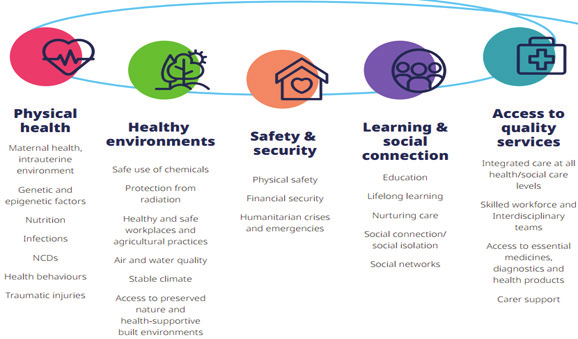
The determinants of brain health are numerous and exert their influence across the entire lifespan, from the perinatal stage through older age. The brain undergoes distinct developmental stages characterized by neuroplasticity, including rapid connection growth in early life, pruning in adolescence, and gradual changes in adulthood. These determinants span five key areas — Physical health, Healthy environments, Safety & security, Learning & social connection, and Access to quality services — and operate at both the individual and societal levels.
Neuroplasticity: The brain is not hardwired
Neuroplasticity is the revolutionary concept that the adult brain is not a fixed, "hardwired" organ, but a dynamic system capable of structural and functional change. This ability to create new neural connections (synaptogenesis) and, in some areas, generate new neurons (neurogenesis) is the biological mechanism underpinning all learning, recovery, and cognitive reserve. We are therefore not victims of inevitable age-related decline; rather, intentional daily action can actively stimulate this renewal or rewiring process.
Daily habits that build cognitive fitness
- Physical exercise — promotes blood flow and the release of BDNF, the brain's "fertilizer".
- Quality nutrition — emphasising omega-3s, antioxidants and whole foods.
- Quality sleep — when the glymphatic system clears metabolic waste.
- Continuous learning — language study, music, complex skills.
- Social connection — engaging in regular, meaningful social interaction.
- Stress management & overall health — managing chronic stress and conditions like diabetes, hypertension and high cholesterol that directly impact vascular brain health.
Crucially, optimizing brain health not only preserves and improves brain function while reducing the risk of CNS disorders but also yields substantial benefits by improving mental and physical health and creating positive social and economic impacts.
In the age of AI and digital complexity, prioritizing brain health is essential for cognitive resilience and guiding future human progress.
No comments yet. Be the first to comment.